
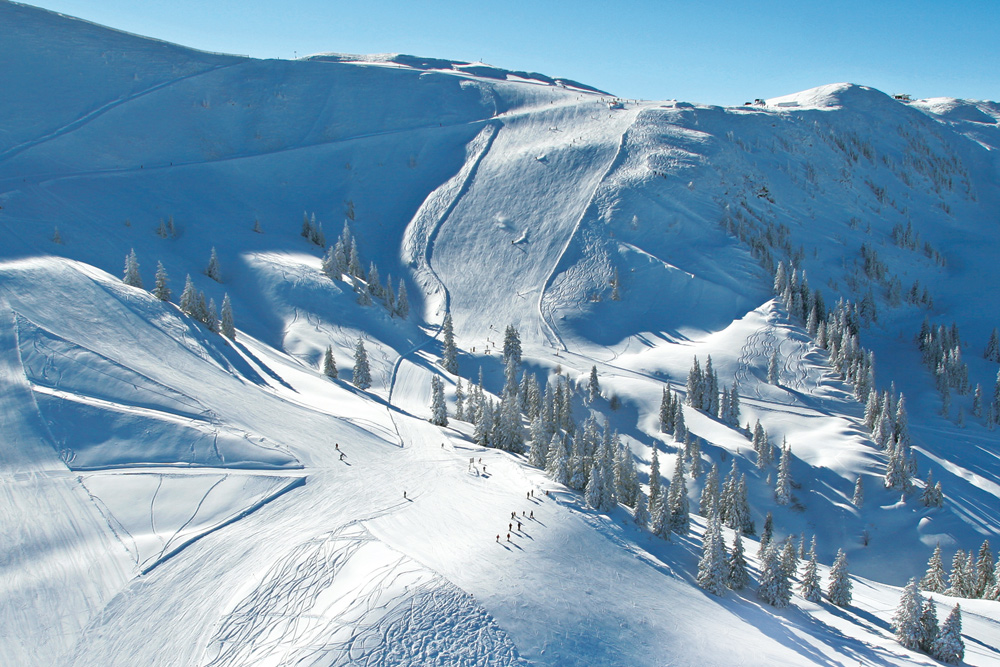
For AlpLuxSki.com, identifying the right mountain for the right level is the ultimate value add. A “Luxury Fail” often happens because an intermediate skier is intimidated by the sheer scale and steepness of a “famous” peak, or an expert is bored by miles of flat “motorways.”
Here is the terrain breakdown by country, focusing on the mountains, their altitude, and the treeline factor.
The Mountain Match: Advanced vs. Intermediate High-Altitude Terrain
The Treeline Rule of Thumb
In the Alps, the treeline typically sits between 1,800m and 2,000m.
- Above the Treeline: Vast, open bowls, glacial terrain, and “Big Mountain” views. High snow security but high exposure to wind and fog.
- Below the Treeline: Sheltered runs through pine forests. Ideal for low-visibility days (snowstorms) and “scenic” cruising.
1. Switzerland: The Technical Giants Zermatt,Switzerland MARCH 25,2017: Skier in Cable car to Matterhorn Glacier Paradise at Zermatt,Switzerland
Intermediate Haven: Zermatt (Matterhorn Glacier Paradise)
- The Mountain: Broad, high-altitude glacial plateaus.
- Why it works: You are skiing at 3,800m, far above the trees. The runs are long, wide, and “blue/red” in difficulty, allowing for effortless carving with the Matterhorn always in sight.
- Altitude Edge: 100% snow-sure even in May.
Advanced Territory: Verbier (The 4 Vallées)
- The Mountain: Rugged, steep, and rocky.
- Why it works: Verbier is famous for its “Itineraries”—marked but ungroomed yellow runs. The Mont Fort glacier (3,330m) offers some of the steepest moguls and off-piste couloirs in the world.
- Altitude Edge: Extreme vertical drop from high-alpine rock faces down to the treeline.
2. France: The Scale of the “High Desert” View of the Val Thorens ski resort of Three Valleys
Intermediate Haven: Courchevel (The 3 Valleys)
- The Mountain: North-facing slopes that keep snow crisp and “grippy.”
- Why it works: Courchevel is famous for “carpet-like” grooming. The terrain is undulating and playful. You can travel from 2,700m down into beautiful pine forests at 1,300m on perfectly manicured runs.
- Altitude Edge: High enough to stay cold, but with world-class snow-making as a safety net.
Advanced Territory: Val d’Isère (Espace Killy)
- The Mountain: “The Face” (Face de Bellevarde).
- Why it works: Val d’Isère is notoriously “stiff” in its grading. A “Blue” here would be a “Red” elsewhere. The terrain is steep, aggressive, and features massive natural bowls above the treeline.
- Altitude Edge: The Pissaillas Glacier allows for high-speed expert runs in the thinnest, coldest air.
3. Austria: The Alpine Engineering
Intermediate Haven: Lech & Zürs (The Arlberg)
- The Mountain: Gentle, snow-blanketed peaks with massive capacity for cruisers.
- Why it works: While it neighbors the aggressive St. Anton, Lech is the “sunny side.” It features wide, open snowfields above the trees that are rarely icy.
- Altitude Edge: While the peaks are lower (2,400m), the Arlberg is a “snow hole” that receives more natural snowfall than almost anywhere else in the Alps.
Advanced Territory: St. Anton am Arlberg
- The Mountain: The Valluga.
- Why it works: This is the cradle of alpine skiing. It is famous for its “deep snow” and massive moguls. The terrain below the treeline is just as challenging as the glaciers above, requiring precise “short-turn” technique.
- Altitude Edge: Steep vertical drops mean you move from icy alpine peaks to heavy forest snow in a single run.
4. Italy: The “Sunny Piste” Specialists
Intermediate Haven: Cortina d’Ampezzo (The Dolomites)
- The Mountain: Tofana and Cristallo.
- Why it works: 90% of the runs are perfectly groomed cruisers. The scenery is UNESCO-protected limestone walls. It is a “social” mountain where the terrain is predictable and stunning.
- Altitude Edge: Most skiing is between 1,500m and 2,300m, right at the treeline, offering the perfect mix of open views and forest shelter.
Advanced Territory: Cervinia (Upper Sector)
- The Mountain: Plateau Rosa.
- Why it works: For the advanced skier in Italy, the draw is the access to Switzerland. Cervinia itself is gentle, but it provides the high-altitude bridge (3,480m) to the technical “black” runs of Zermatt’s south face.
- Altitude Edge: One of the few Italian resorts that is almost entirely above the treeline.
Comparison Summary: Where to Send Your Clients
| Goal | Country | Best Resort Mountain | Altitude Vibe |
| Intermediate/Snow Sure | Switzerland | Zermatt | High Glacial / Wide |
| Intermediate/Cruising | Italy | Cortina | Sunny / Dramatic Walls |
| Advanced/Steeps | France | Val d’Isère | Rugged / High-Bowl |
| Advanced/Moguls & Off-Piste | Austria | St. Anton | Technical / Tree-Line |